


The PGE Capital Group is aware of the impact of its operations on the climate, as well as the threats resulting from climate change for the Group's operations. This interdependence generates both risks and opportunities for development. Therefore, the expectations of stakeholders in terms of reporting the impact of activities on the climate as well as dependence on it are understandable, recognising climate risk management as a key element of strategic management, with a direct impact on financial aspects.

Interdependencies between climate and PGE Group's activities
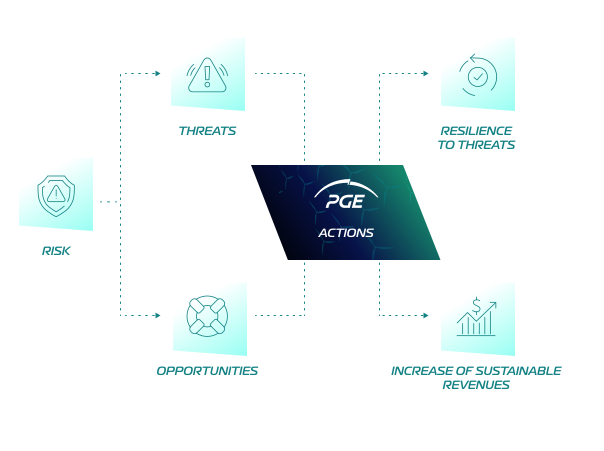
The PGE Capital Group focuses not only on risks, but also on opportunities to ensure resilience to threats and increase the Group’s sustainable revenues. PGE Capital Group undertook a number of actions aimed at achieving climate neutrality in 2050.
The Group has also stepped up its efforts to meet the regulatory requirements, both national and European. A Sustainability Statement for 2024 has been prepared, based on the CSRD12), the European Sustainability Reporting Standards (ESRS), and the Accounting Act. The Sustainability Statement is included in the Management Board Report on activities of the PGE CG. The PGE Capital Group is also obliged to disclose the extent to which its business activities can be considered environmentally sustainable. This requirement results from Regulation (EU) 2020/852 of the European Parliament and of the Council on the establishment of a framework to facilitate sustainable investment, and amending Regulation (EU) 2019/2088, and from the related Delegated Regulations on the establishment of a framework to facilitate sustainable investment. The activities of the PGE Group in terms of the EU Environmental Taxonomy are described in section 9.2.1 of this report.
Issues related to climate risk are subject to the rigors and guidelines resulting from the corporate risk management process. The body responsible for overseeing the corporate risk management process in the PGE Group, including climate risk, is the Risk Committee as in the case of financial risks. The establishment of a Risk Committee at the highest management level, reporting directly to the Management Board, ensures supervision over the effectiveness of risk management in the Group. Such a location of the risk function allows for an independent assessment of individual risks and their impact on the PGE Group as well as mitigation and control of significant risks using dedicated instruments.
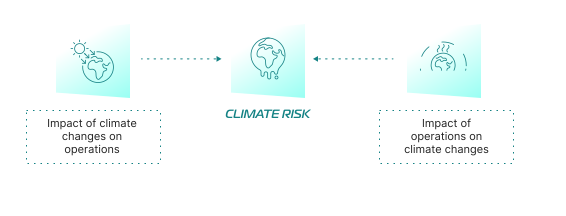
The assessment of climate and environmental risks is carried out on the basis of the General Procedure for Corporate Risk Management. In the PGE Group, climate-related risk is analysed both in the context of the impact of climate change on the business and the impact of business on these changes. Identification and analysis of climate-related risk and continuous improvement of pro-environmental solutions as well as control tools allow for effective management and minimisation of climate impact, while caring for the PGE Group’s financial results. The solutions developed by the PGE Group are aimed at its development and sustainable transformation in accordance with climate requirements and care for all stakeholders.
Interdependencies between climate and PGE Group's activities
Climate issues are assessed centrally at PGE S.A. taking into account all types of activities of the Capital Group and entities that are part of it. This means that the result of the provided assessment is joint, at the PGE Capital Group level.
The approach to the issue of climate risks is inspired by the recommendations of the Task Force on Climate-related Financial Disclosures (TCFD), however, the adopted method for the inventory and assessment of risks is an internal concept of PGE.
In 2024 PGE Group once again participated in an international study on the company’s environmental impact i.e. the Carbon Disclosure Project – CDP (https://www.cdp.net/en), an international study on corporate environmental impact. The Group responded to enquiries from global investors about the impact of its operations on climate, water and forest resources and analysed both risks and opportunities related thereto.
There is an interdependence between the risks and opportunities for businesses associated with the climate. Any business is affected by two types of climate risks:
- physical risk, related to the physical effects of climate change i.e. real threats in the form of extreme weather events, drought, flooding,
- risks associated with the transition (so called transition risks) to a low-carbon and climate-resilient economy, which relate to meeting regulatory requirements, implementing new technologies or impact on the reputation of a business.
The changing climate and efforts to combat climate change, i.e. to mitigate and adapt to its effects, provide at the same time new opportunities and chances to develop business. This is why PGE Group focuses not only on risks but also on opportunities so as to ensure resilience to risks and to increase sustainable earnings.

Each of these areas of climate risk is assessed on a short, medium and long horizon. The adopted timeframes are aligned with external analyses.


Assessment of the impact of physical climate risks on the operations
Global warming, changing precipitation patterns, rising sea levels and extreme weather events are increasingly challenging the resilience of power systems, increasing the likelihood of disruption. Climate change directly affects every segment of the power system: production potential and efficiency, demand for heating and cooling, resilience of transmission and distribution networks, as well as demand patterns.
Being aware of the threats arising from climate change, as part of the first stage of the climate risk management process in 2024, the PGE Group once again carried out an assessment of key physical (material) climate risks that may have a negative impact on its operations, supporting adaptation to climate change and increasing resistance to climate threats. Climate factors, primarily temperature, precipitation and wind, were assessed and their negative impact on key activities in the Group was examined.

The assessment of the risk related to climatic physical threats in PGE Capital Group in 2024 was carried out in the current and long-term perspective using scientific models describing possible climate scenarios.
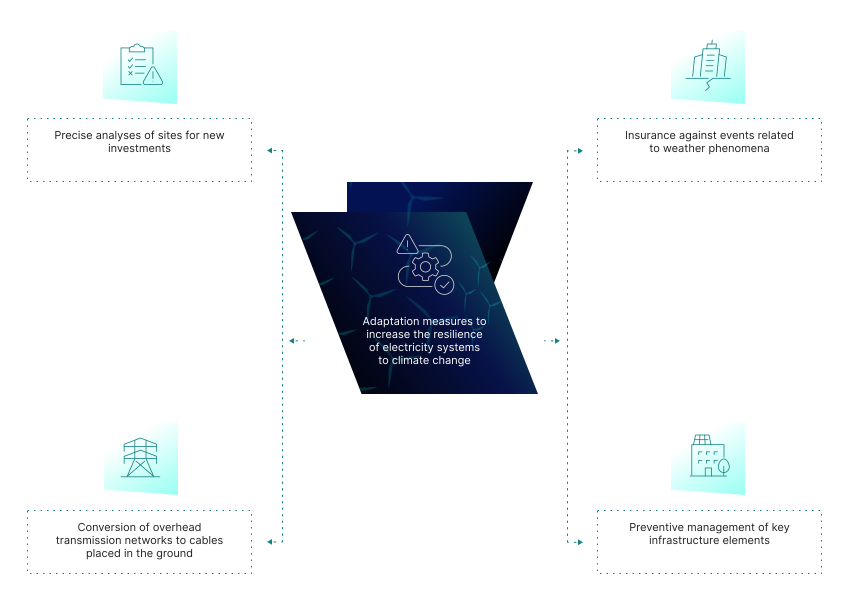
The assessment carried out showed a low or medium impact of risks related to physical climatic hazards on the key activities of the Capital Group in 2024. An important role in the assessment process is played by e.g. implementation of adaptive measures developed in the PGE Capital Group.
Adaptation measures in the PGE Capital Group
Impact of transitional climate risks on operations
Transformational climate risks in the PGE Capital Group relate primarily to areas affecting the change towards achieving climate neutrality planned by 2050, i.e., among others: requirements and regulations of existing products and services (area: policy and law), replacement of existing products and services their low-emission and zero-emission counterparts (technology area) and stakeholder concerns/negative opinions (reputation area). Examples of risks from the above areas are listed below, divided into categories:
Climate regulations have a direct impact on energy companies. PGE Capital Group companies, like other entities in the energy sector, are exposed to risks and threats resulting from the nature of their operations and functioning in a specific market and regulatory and legal environment. The PGE Capital Group operates in an environment that is significantly influenced by domestic and foreign regulations. The risk of current regulations is particularly important in the context of raising capital, subsidies and support from aid funds.
The PGE Group undertakes a number of activities related to the monitoring of available sources of support, reliable preparation of application documentation and the use of expert know-how. The PGE Capital Group has extensive experience in obtaining preferential support, and has the knowledge and staff to successfully implement this process.
The arising regulations are important from the point of view of implementing the strategy and supporting the effective transition to low- and zero-emission technologies. The PGE Capital Group strives to fully use the available financing options for green investments. Emerging regulatory changes, such as EU infrastructure support for sustainable investments, the inclusion of lack of financing, penalties for climate-negative transactions, may raise significant risks. These changes will affect the credit risk and may affect the financial flows generated by assets belonging to the PGE Capital Group and thus affect their income value.
The risk of rising costs of greenhouse gas emission allowances, including the reduction of the limit of free emission allowances for the district heating sector, reduces the ability to finance low- and zero-emission investments.
The Group invests in the modernisation of assets and development investments, including the optimisation of combustion processes and the introduction of solutions aimed at improving production efficiency, higher efficiency of fuel and raw material consumption, and reducing the energy intensity of production processes and internal needs.
A permanent reduction in emission intensity is to be achieved in the PGE Capital Group by changing the generation technology, investing in new technologies, expanding the portfolio of renewable energy sources, developing the circular economy and enabling customers to participate in the energy transformation. Technological risk also includes the selection of optimal and effective new technologies, the use of the potential by the Group.
Reputation risk in the case of the PGE Group is very important, because the energy sector plays a key role in supporting the effective transition to a low-carbon economy, and ultimately a zero-carbon one. The Group focuses on reducing its impact on the natural environment. A permanent reduction in emission intensity is to be achieved by changing the generation technology, expanding the portfolio of renewable energy sources and enabling customers to participate in the energy transformation by offering them attractive products. Lack of due attention to the low-carbon economy and ESG issues can cause problems with access to capital.
12 CSRD- Corporate Sustainability Reporting Directive.